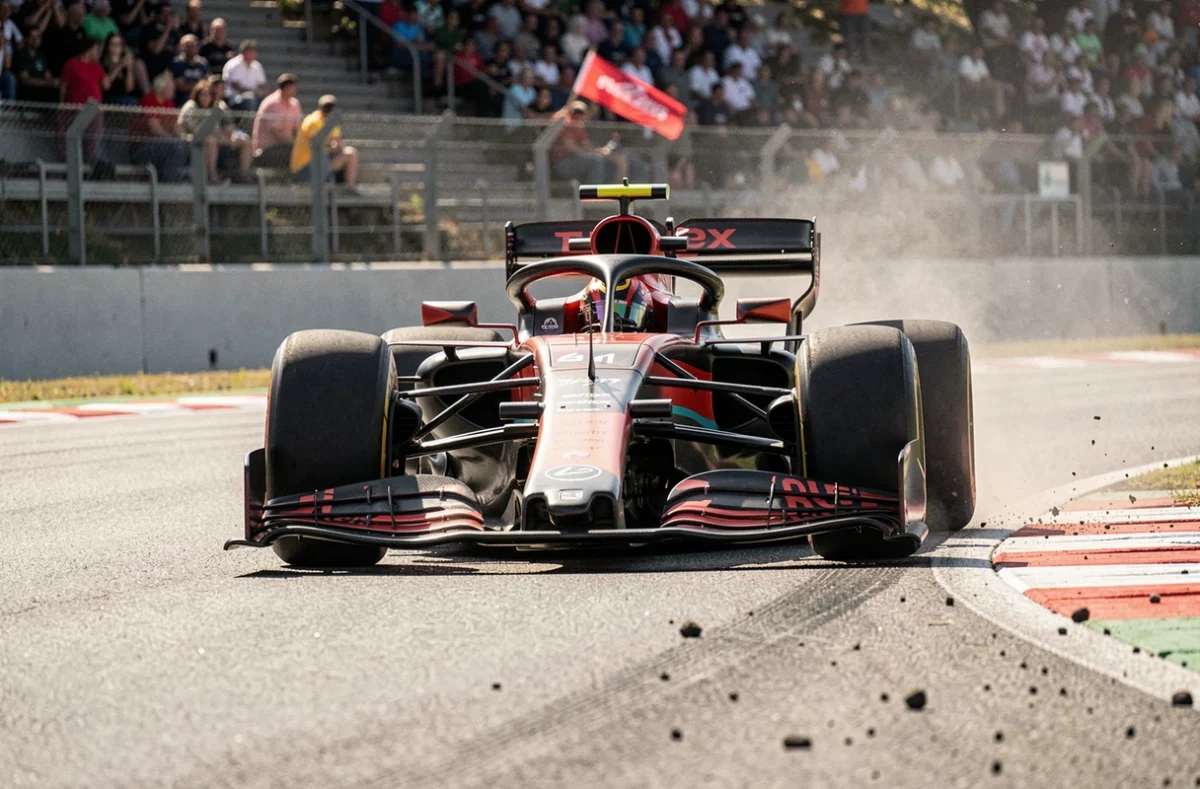
The lift and coast refers to the action of releasing the throttle before the usual braking point, then allowing the car to decelerate freely over a few dozen meters. In Formula 1, this technique is used to preserve stored energy, reduce brake wear, or save fuel depending on the generation of regulations. With the arrival of the 2026 power units, lift and coast transitions from a discreet stopgap to a central strategic variable.
Energy recovery and active aerodynamics: lift and coast version 2026
The 2026 technical regulations profoundly change the purpose of lift and coast. The MGU-K can now provide up to 350 kW of electrical power, compared to 120 kW in the previous generation. The maximum recovery per lap reaches 8.5 MJ. This doubling of electrical capacity transforms each deceleration phase into a recharging window, and lifting off the throttle is no longer just a fuel-saving measure.
The most notable change concerns the interaction between recovery and aerodynamics. During the lift-off, energy recovery can be accompanied by the closing of active aerodynamic devices, which increases drag. The driver faces a new trade-off: recover maximum energy in a straight line or maintain low resistance to keep up speed.
This compromise did not exist under previous regulations. To understand lift and coast in F1, one must now integrate this aerodynamic dimension that makes the action much more complex than simply releasing the pedal.

Energy management per lap: where and when the driver lifts off
Lift and coast is no longer limited to the braking zone at the end of the straight. The 2026 systems allow energy recovery at several points during the lap: approaching a slow corner, exiting a fast curve, or even in the middle of a full-throttle section if the energy budget requires it.
This multi-point distribution changes the driver’s reading of the circuit. On a track like Monza, where long straights traditionally favor top speed, energy recovery can occur at three or four distinct points per lap. The race engineer communicates in real-time the suitable lift-off areas based on the battery charge state and overall strategy.
The trade-off between immediate performance and energy reserve
Each lift-off costs time per lap. Teams estimate the loss per lift and coast phase and compare it to the gain obtained from the recovered energy, deployed later as additional power. This calculation varies from lap to lap depending on tire temperature, remaining fuel level, and track position.
A driver who recovers too much energy early in the stint may end up with a full battery but tires degraded by the deceleration jolts. Conversely, a recovery deficit forces driving in reduced mode in subsequent laps, exposing them to overtakes.
- The closing of active aerodynamic devices during recovery increases drag and slows the car in a straight line.
- Recovery during braking remains the most efficient in terms of energy recovered per meter lost, but it puts more strain on carbon brakes.
- The deployment of recovered energy can be concentrated at the exit of a slow corner, where longitudinal acceleration provides the greatest timing advantage.
Lift and coast in qualifying: the regulatory changes of 2026
Lift and coast in qualifying posed a problem of sporting readability. During the first tests under the 2026 rules, drivers had to lift off even on a flying lap, resulting in times that were not representative of actual performance. The high speeds between cars also raised safety concerns.
F1 officials revised the power unit regulations during the April break, aiming to reduce the necessity of lift and coast in fast corners and allow drivers to produce qualifying laps closer to maximum attack.
Field feedback varies on the effectiveness of these adjustments, as some teams believe the energy budget remains tight enough to necessitate a lift-off on tracks with long straights.

Driving and driving style in relation to the energy budget
The debate centers on the driver’s ability to adapt their attack without distorting their natural driving approach. The 2026 regulations change the balance between different driving styles.
A driver with a late and aggressive braking style recovers more energy through deceleration but wears out their brakes faster. A driver with a smoother style, who anticipates corners and lifts off gradually, recovers less during braking but better preserves their tires and mechanical components.
The physical and mental dimension of lift and coast
The mental load associated with energy management represents a major challenge under the 2026 regulations. Managing lift and coast lap after lap, integrating radio instructions and battery data displayed on the steering wheel, requires sustained concentration throughout the race.
Energy management in the 2026 race resembles less a conservation exercise and more a continuous optimization between recovery, deployment, and trajectory. Lift and coast is no longer an admission of mechanical weakness. It is an integral part of the driver’s technical repertoire, alongside braking points and steering angles at corner entry.