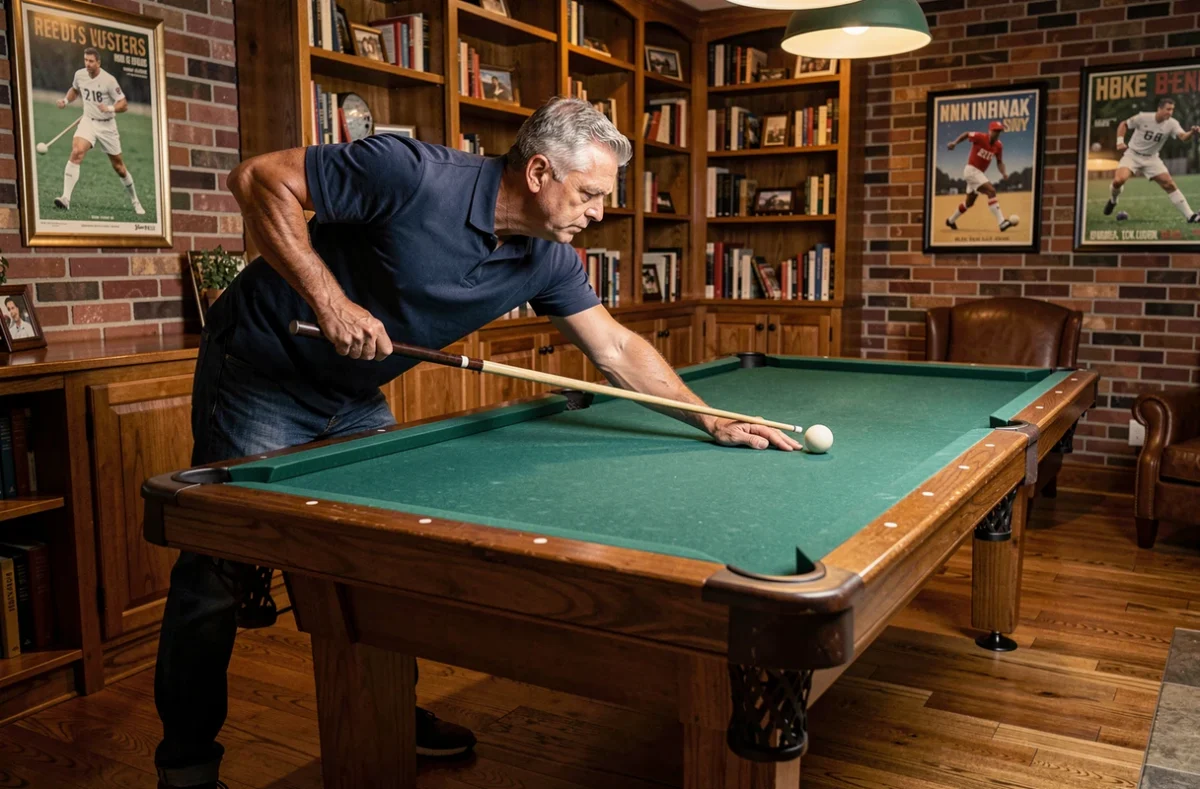
An American pool table is sized based on the free space around the table, not from the table itself. The necessary cueing space often exceeds the surface of the furniture. Before choosing a size, the first measurement to take concerns the living room, its obstacles, and its passages, much more than the manufacturer’s catalog.
Measure the free space in the living room before the American pool table
Most buyers start by choosing a model and then check if it fits in the room. The reverse approach avoids unpleasant surprises. What matters is not the total area of the living room, but the space actually cleared around the intended location.
A sofa back, a radiator, a windowsill, or a kitchen island create obstacles at cue height, about 80 cm from the floor. A spacious but cluttered living room sometimes offers less playable area than a more modest and empty room.
The method is simple: measure the length and width of the cleared space, not counting areas occupied by fixed furniture. Then subtract the cueing margin from each side. This calculation determines the maximum size of table that your room can accommodate. A practical guide on Expertise Maison details this method step by step, with recommended margins according to the format.
Another often overlooked point: the delivery path influences the choice as much as the room. Door widths, hallways, stairs, turns, and elevators must be checked before purchase. Models equipped with a multi-part slate are heavy, and some access points make delivery physically impossible despite a suitable living room.
Cueing space and cue length: the real size criterion
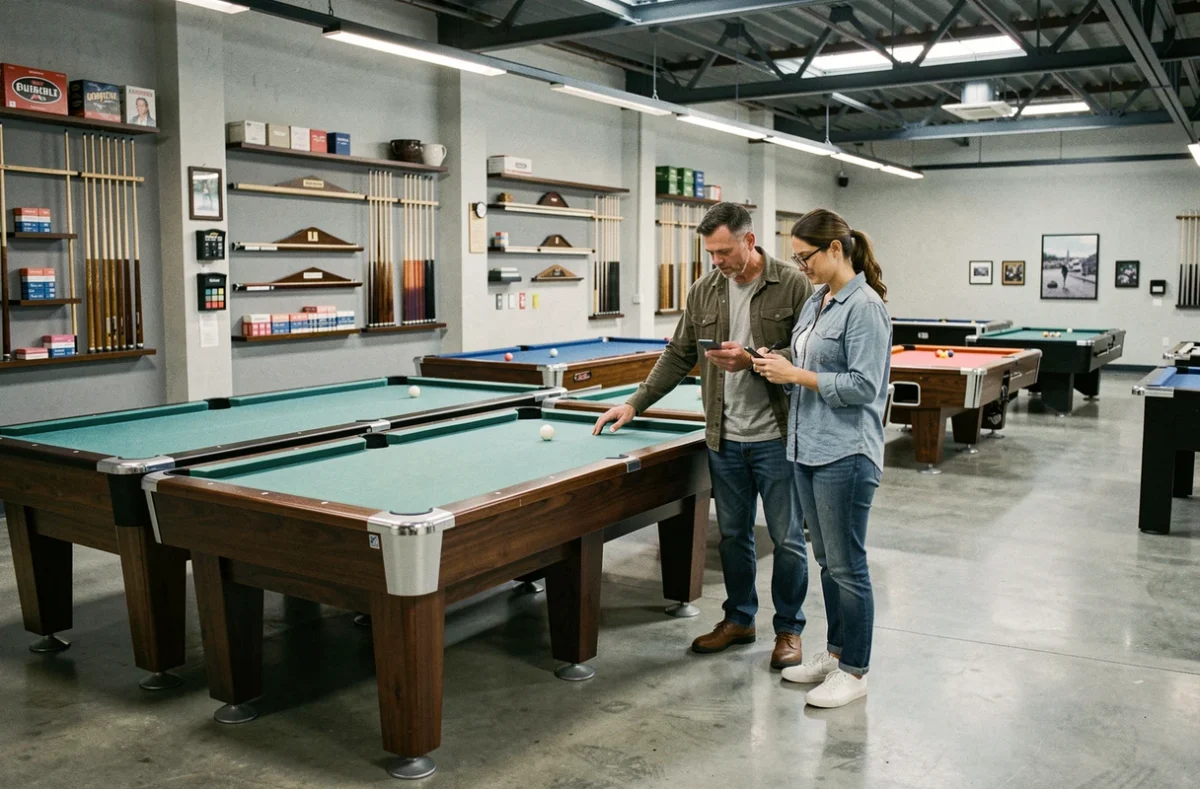
The basic rule for playing comfortably with a standard cue of about 140 cm requires significant cueing space all around the table. This margin absorbs the player’s cueing motion, with the arm extended backward.
When one side of the living room is constrained by a wall or furniture, a shorter cue can broaden the layout possibilities. Cues of 120 cm or 100 cm exist specifically for these situations. The trade-off: slightly less fluid play on long shots, which remains acceptable for family use.
Here are the elements to check to calculate your cueing space:
- The length of the cue you plan to use (standard, short, or telescopic) – it directly determines the necessary margin on each side
- The presence of fixed obstacles at cue height (radiator, windowsill, console, sofa back) that reduce the playable area even if the floor seems clear
- The circulation passages in the living room – a service corridor between the pool table and the wall prevents proper play from that side
Testing the configuration before purchase remains the most reliable method. Mark the outer dimensions of the target pool table on the floor with tape, then simulate a cue movement all around. Areas of obstruction become immediately apparent.
Common sizes of American pool tables: 7, 8, or 9 feet
The size of an American pool table is expressed in feet and refers to the playing surface measured between the nose of the cushions, not the external dimensions of the furniture. The thickness of the frame and cushions adds several centimeters on each side, which alters the actual footprint.
The 7-foot size is the most compact. Used in bars and small game rooms, it is suitable for modest-sized living rooms. The compromise lies in the playing experience: the angles are tighter and the ball trajectories shorter.
The 8-foot size represents the most common intermediate format in homes. It offers a good balance between playing comfort and footprint. This is the format to prefer when the room allows, as it approaches real playing conditions without requiring a dedicated room.
The 9-foot size corresponds to the American competition standard. It requires a significantly larger room and is aimed at regular players or dedicated spaces. A format of 2.80 m long, with the cueing margin on each side, assumes a room whose smallest dimension exceeds five meters by a large margin.
Convertible pool table: a separate sizing
Convertible pool tables, which also serve as dining tables, add an additional constraint. The space for chairs and guests encroaches on the shooting area if the living room is not large enough to clearly separate the two uses.
The height of the furniture also differs from a classic pool table. A dining table surface is higher than a standard playing surface, which alters posture and comfort. Before opting for this type of furniture, ensure that the floor can support the total weight (table, slate, conversion top) without risk of deformation.
Relationship between table format and actual playing surface
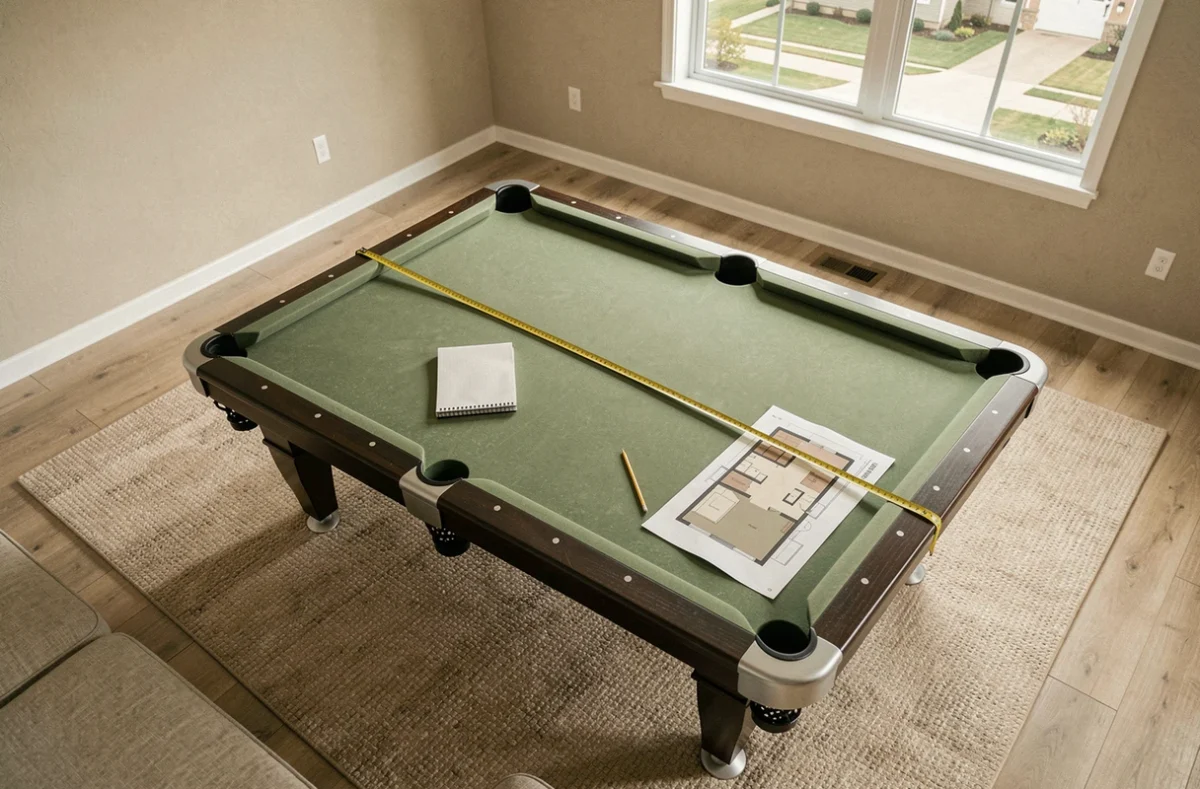
A common trap is to compare pool tables solely based on their advertised size in feet. Two pool tables labeled “8 feet” by different manufacturers may have slightly different playing surfaces, depending on the thickness of the cushions and the design of the frame.
The proportional characteristic to remember: the length of the playing surface must be equal to twice its width. A pool table that does not adhere to this ratio alters the rebound angles and distorts the trajectories. This point deserves verification on entry-level models, where manufacturing tolerances are sometimes wider.
For family use in a living room, the format matters less than the consistency between the chosen size, the available space, and the length of the cues used. A 7-foot pool table installed with comfortable cueing margins provides more enjoyment than a 9-foot table wedged between two walls where every shot requires a short cue.