
Returning mail received by mistake may seem trivial, but the process varies depending on the nature of the error: wrong name on a correct address, correct person at an outdated address, or package delivered to the wrong place. Each case requires a different action, and confusing these situations often leads to mail that circulates endlessly in the postal system without ever reaching its true recipient.
Name error, address error, former tenant: three distinct cases
| Type of error | Common cause | Appropriate action | Note to include |
|---|---|---|---|
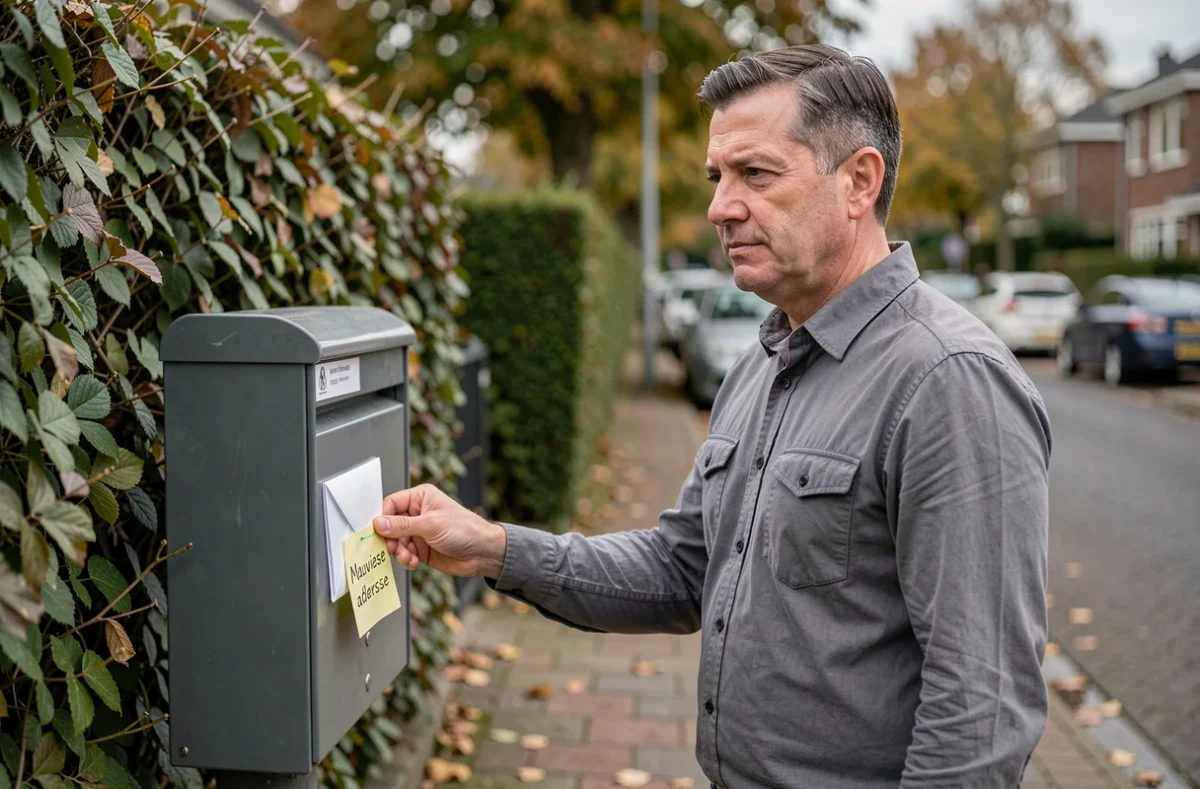
| Wrong recipient, correct address | Sender’s input error | Place the mail in a yellow box | “Does not live at the indicated address” |
| Correct recipient, wrong address | Outdated database | Contact the sender to correct | “Return to sender – address error” |
| Mail for a former tenant | No forwarding after moving | Write NPAI on the envelope | “NPAI” (No Longer at the Indicated Address) |
| Package delivered to the wrong home | Delivery error | Contact the delivery service | No handwritten note, online report |
This table highlights a often overlooked point: the handwritten note you write on the envelope determines how it is processed by the sorting center. An incorrect note can delay the return by several weeks.
The note NPAI, for example, triggers a specific process at La Poste that informs the sender that the address is no longer valid. If you simply write “error” without further details, the mail may end up being returned to you.
To properly understand how to return mail to the correct address based on your situation, you must first identify which of these four categories applies to your case.
Mail opened by mistake: the real legal risk
Opening mail that is not intended for you, even by mistake, touches on the secrecy of correspondence. This principle protects all mail addressed to others, and its violation can constitute an offense.
In case of accidental opening, the procedure is simple but precise:
- Do not disclose the contents of the mail, even verbally to a neighbor or via message
- Reseal the envelope and add the note “opened by mistake” with your signature
- Report the error to the carrier or directly to the sender if their contact details are on the envelope
- If the mail contains banking or medical information, prefer a return with tracking to keep proof of delivery
CNIL reminds that disclosing personal data, even unintentionally, can constitute a data breach and cause harm to the individuals involved. Resealing the envelope and returning it to the postal system remains the only safe action.
Simple return or return with tracking: which postal return method to choose
Placing the mail in a yellow mailbox with the appropriate note is sufficient in the vast majority of cases. The postal service will redirect it to the sender at no cost to you.
However, when the mail contains sensitive documents (bank statements, administrative letters, medical documents), a drop-off with tracking offers additional protection. La Poste offers tracked shipments that provide a proof of deposit and digital evidence accessible online. This proof can be useful in case of a dispute if the recipient or sender contests the good faith of your action.
The cost remains your responsibility in this second case. For ordinary mail without particular value, using the yellow box is the fastest and most suitable solution.
When the problem recurs
Receiving foreign mail occasionally is common. Receiving regular mail in the name of an unknown person or a former occupant indicates a deeper malfunction.
Repeated errors may reveal a data leak beyond a simple postal error. If several different recipients appear on mail received at your address, it may be a fraudulently used address. In this case, reporting to La Poste and possibly to CNIL becomes relevant.
Placing a label on your mailbox with your first and last name also reduces distribution errors. Postal workers rely on this identification to sort mail during their rounds.
Forwarding and return to sender: two different postal circuits
Online competitors often confuse forwarding and return due to error. However, the distinction is crucial.
Mail forwarding is a paid service intended for people who are moving. It redirects all mail for a name to a new address for a defined period. This service does not correct a one-time addressing error: it can only be subscribed to by the person concerned, not by someone receiving the mail by mistake.
Return to sender, on the other hand, is free and requires no subscription. You simply need to cross out the address, write the appropriate note, and return the unopened envelope to the postal system. The postal worker will then redirect the mail to the return address printed on the envelope.
If no return address is on the envelope, the mail is directed to the postal waste processing center, where it will be kept for a certain time before destruction.

The difference between these two circuits explains why some people continue to receive mail despite their repeated reports: they request forwarding when the issue is simply a return, or vice versa. Identifying the correct circuit from the start avoids several unnecessary trips between your mailbox and the sorting center.